Triple Harvest™: 3D Match Game
- 4.9
- Rating
- 1.00M
- Installs
- Free
- Price

 Analysis by App-foxy
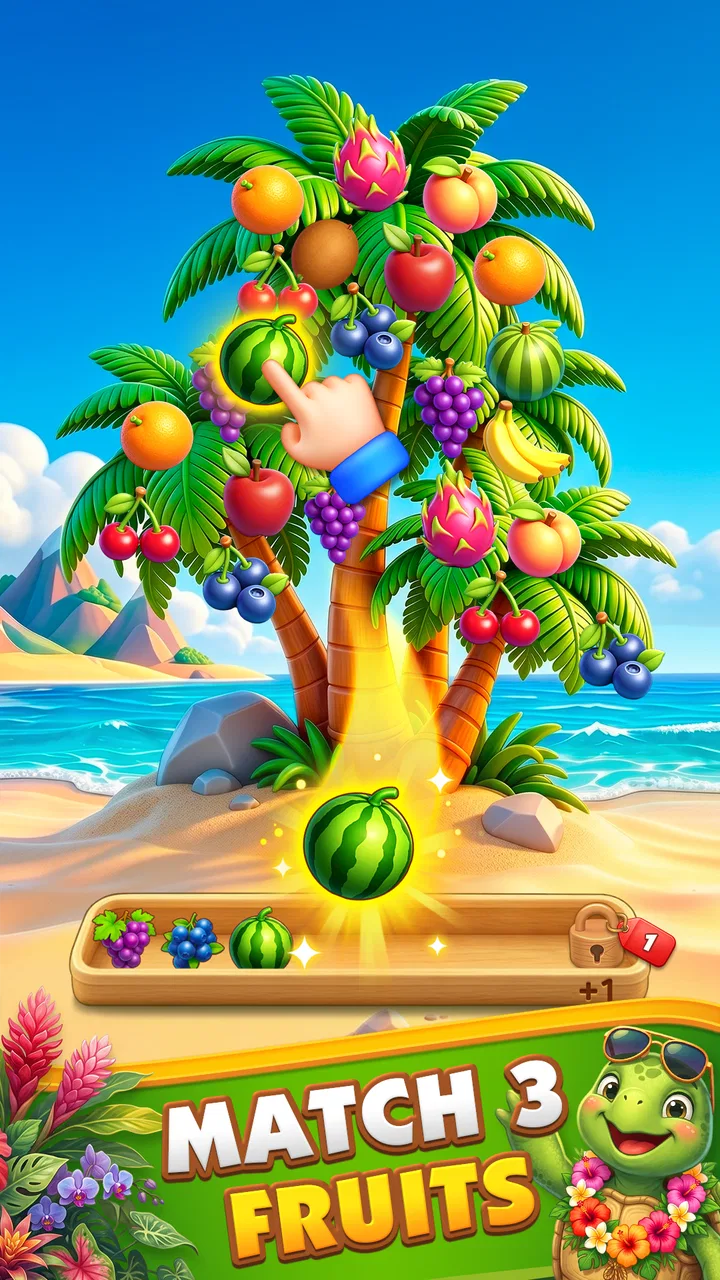
I found Triple Harvest™ most interesting as a puzzle game for short, quiet sessions rather than as a title built around speed or competition. It comes from Flyfox Games and presents a three-dimensional matching idea with a harvest theme: the player looks through a group of objects, identifies three matching items, and clears them. That simple loop is easy to understand, but the way it is presented matters a lot when the screen becomes crowded.
As a free game in the puzzle category, it is easy to try without making an immediate purchase. It is rated for Everyone, runs on Android 7.0 and later, and its current version is 1.1.1. The audience is already substantial, with over a million installs, a 4.9 average from around 36 thousand ratings, and 201 written reviews. Those figures suggest that the basic concept has broad appeal, although I would still judge it by how comfortably it fits your own eyes, hands, device, and tolerance for optional spending.
How clearly the game presents its puzzle
I focus here on how the game makes its matching goal understandable, because that first impression shapes whether the three-dimensional board feels inviting or busy. I also consider how a little deliberate scanning can make the puzzle easier to approach. From there, the next section looks at how the layered layout changes the choices I make while playing.
You May Also Like

 Blood Strike: 2.5 Anniversary
Blood Strike’s Loadouts Turn Every Drop Into a Tactical Gamble
A close look at Blood Strike’s custom loadouts: how fast access to signature weapons reshapes its battle royale rhythm, rewards preparation, and narrows the gap between fights.

 Pandora - Music & Podcasts
Pandora’s Music Is Easy to Start, but Harder to Recover
Pandora’s strength is its low-effort path from a seed to a station. Its weak spot is how much confidence it asks you to place in connection, setup, and quiet recovery.

 8 Ball Pool
 Is Built on Rivalries, Rematches, and Routine
A close look at the rivalries, rematches, shared routines, and unanswered safety questions that turn a quick pool match into a persistent mobile community.

 Samsung Music
’s Quiet Strength Is Playing What You Already Own
Its reach comes less from spectacle than from dependable access to a personal library. That simplicity is both the app’s strongest retention engine and its ceiling.

 AccuWeather: Weather Radar
AccuWeather Review: A Quick, Clear Forecast for Everyday Decisions
For everyday plans, the best forecast is the one you can understand quickly. AccuWeather makes rain timing, radar, and local conditions easy to act on, with a few trade-offs.

 Hill Climb Racing
Why Hill Climb Racing Still Turns Crashes Into One More Run
A tiny car, a bumpy hill and one more upgrade: Hill Climb Racing keeps resurfacing because its simple chaos makes every near-miss feel personal.
More From Our News Desk



Readability and navigation
The strongest part of the experience is the immediate goal. I never needed a long explanation to understand that I should search the three-dimensional pile for identical harvest-themed objects and make a set. That directness is valuable for players who prefer learning by doing, and it also makes the game approachable for someone who does not usually play puzzle titles.
The three-dimensional arrangement adds interest, but it also creates the main readability challenge. A flat matching game usually lets me scan rows and columns in a predictable way. Here, objects can feel visually layered, so I have to inspect the pile rather than simply read it from left to right. That makes a successful match more satisfying, but it can slow down anyone who finds overlapping shapes, small icons, or busy scenes tiring.
I recommend starting with a deliberate scan instead of tapping the first familiar object I notice. I look for one possible trio, then check whether the other two items are genuinely available rather than partly hidden. This small habit reduces accidental selections and makes the board feel less chaotic. It is also a useful approach for players who need extra time to interpret a scene before acting.
The navigation is best understood as a visual search task. The game does not ask me to memorize complicated rules, but it does ask me to keep track of what I have seen. Players who enjoy spotting patterns will probably find that comfortable. Players who prefer clearly separated tiles and fixed positions may find a conventional two-dimensional match-three game easier to read.
One practical strength is that the concept does not depend on reading long passages. The central action is communicated through objects and matching relationships, which can make the game more approachable for people who are less comfortable with text-heavy interfaces or who simply want to play without concentrating on dialogue. The trade-off is that visual clarity becomes more important than it would be in a menu-driven puzzle.
What the three-dimensional layout changes
The 3D presentation is not just decoration. It changes how I plan each move. I have to consider which visible item belongs to a possible trio and whether clearing one group will make another object easier to see. That creates a gentle layer of board awareness beyond simple recognition.
My most useful tactic was to avoid completing every available trio immediately. When several matches are visible, I first look for the group that appears to be blocking the largest number of other objects. Clearing that kind of match can improve the next scan and prevent the board from becoming visually confusing. It is a modest planning skill, but it makes the game feel more thoughtful than a purely reflexive tapping exercise.
This approach also reveals a limitation. If you have difficulty distinguishing depth, overlap, or similarly shaped items, the 3D arrangement may demand more effort than the relaxing theme suggests. The game can still be enjoyable, but it may require slower play, larger viewing distance, or a device with a screen that makes object boundaries easier to see.
For a parent introducing the game to a child, I would play alongside them at first rather than assuming the simple premise explains everything. The child can learn the matching rule quickly, while the adult can demonstrate how to pause and inspect the whole pile before choosing. That turns the game into a small exercise in observation instead of a race to tap rapidly.
Motor and sensory considerations
The core interaction appears well suited to players who prefer tapping over complicated controls. There is no need to learn a virtual joystick or coordinate several buttons at once. I can focus on selecting objects, which lowers the physical complexity compared with action games. For someone with limited dexterity, that may be more comfortable than fast arcade play, especially when approached at a relaxed pace.
However, simple tapping does not automatically make a game accessible to every player. The player still needs to target individual objects accurately, and a crowded three-dimensional board can make a tap feel less certain. A person with tremors, reduced precision, or difficulty maintaining a steady touch may find small or overlapping targets frustrating. In that situation, a slower puzzle with larger, widely spaced tiles could be a better fit.
I also would not describe the game as ideal for anyone who is sensitive to visual clutter without testing it personally. The harvest theme gives the board a friendly identity, but multiple objects competing for attention can still create sensory fatigue. I found that short sessions worked better than forcing myself to continue after my concentration dropped. The relaxing mood depends partly on treating the game as a calm activity, not as a task to finish as quickly as possible.
One useful routine is to lower the pressure I put on each board. Instead of searching the entire pile repeatedly, I divide it mentally into small areas and inspect each area once. This reduces unnecessary eye movement and makes it easier to remember where a matching item appeared. It is especially helpful when I am playing in a dim room, on a smaller phone, or after a long day when visual attention is limited.
The game may suit players who want a quiet alternative to reflex-heavy entertainment, but it is not automatically the best option for someone who needs strong nonvisual feedback. The matching task is fundamentally visual, so anyone who relies heavily on audio cues should consider whether that kind of play is comfortable before committing time or money. I would also avoid assuming that a general Everyone rating answers individual accessibility needs; age suitability and personal usability are different questions.
Situational access in everyday play
I can imagine using this game during a short break, while waiting for an appointment, or at the end of the evening when I want something more active than watching a video but less demanding than a competitive game. The basic matching idea makes it easy to resume mentally after a distraction. If I am interrupted, I do not need to remember a complicated story or a long chain of instructions.
That same quality makes it suitable for casual shared play. I could hand the phone to a family member and explain the objective in a few seconds. One person can point out possible matches while another taps, although this works best when both people agree to play slowly. The 3D arrangement gives spectators something to discuss because a hidden or overlooked object can change which trio is most useful.
It is less suitable when I need to keep my attention on another responsibility. A puzzle that looks relaxing can still require enough visual concentration to make it a poor choice while walking, crossing a street, cooking, or supervising a situation that needs immediate attention. The best setting is seated, stable, and free from avoidable distractions.
For travel or waiting rooms, the game’s free entry point is convenient. I can try the central loop without first deciding whether the purchase is worthwhile. Still, I would treat optional purchases carefully. The listed in-app purchase range runs from $0.99 to $49.99 per item, so the difference between a small convenience purchase and a much larger one is significant. I would recommend setting a personal spending limit before playing, particularly if the game becomes part of a daily routine.
The free price is therefore a genuine advantage for sampling, not a guarantee that every part of the long-term experience will feel cost-free. I would play several sessions, notice whether I enjoy the search itself, and only then decide whether any optional purchase adds enough value for me. If I dislike the basic board-reading loop, spending more will not fix that underlying mismatch.
Remaining barriers and who may want another puzzle
The biggest barrier is the combination of visual density and precision tapping. A player who wants very large, clearly separated pieces may feel more comfortable with a traditional tile-matching game. Those alternatives usually sacrifice the depth effect, but they can make scanning faster and reduce uncertainty about which item is selectable.
Another barrier is the possibility of mental fatigue. Matching three objects sounds effortless, yet repeated searching through layered scenes can become demanding when I am tired or dealing with glare. I found the game more pleasant when I treated it as a sequence of small observations rather than a test of speed. Anyone looking for a completely passive relaxation tool may prefer a simple coloring app, ambient game, or puzzle with fewer visual decisions.
Players who enjoy intense challenge may also find the gentle presentation too restrained. The harvest setting and straightforward objective point toward casual play. If your ideal puzzle involves deep deduction, wordplay, or elaborate logic chains, this is probably not the right substitute. Its appeal comes from recognition, organization, and the satisfaction of clearing a trio, not from solving a long mathematical problem.
Device choice can make a meaningful difference. On a larger screen, I expect the objects to be easier to separate and inspect. On a compact phone, I would hold the device at a comfortable distance and avoid rushing. I would also pause if the board began to blur into one mass. That is not a flaw unique to this game, but the 3D layout makes screen size more relevant than it is in a minimalist puzzle with oversized tiles.
The developer, Flyfox Games, has positioned the title around a very accessible premise, and the high average rating indicates that many players enjoy the result. I still would not use popularity as a substitute for a personal trial. Ratings tell me that the concept works for a large audience; they do not tell me whether the visual arrangement will suit a particular player’s eyesight, motor control, attention span, or spending preferences.
Small strategies that improve comfort
My first recommendation is to scan before touching. I look for repeated objects, identify a likely trio, and only then begin selecting. This avoids turning the board into a collection of half-started choices that I need to remember. It also gives players who process visual information more slowly a natural rhythm: observe, decide, tap.
My second recommendation is to use the board’s changing visibility to guide priorities. If one match appears to sit in front of several other objects, I consider clearing it before an easier trio in an open area. The goal is not merely to make any match; it is to make the next part of the board easier to understand. That is the most important strategic difference I noticed between casual tapping and thoughtful play.
Third, I would stop treating speed as the measure of success. A slower player can still make better decisions by checking whether a selected object belongs to a useful group. This matters for children, older players, and anyone who becomes uncomfortable when a game seems to demand rapid reactions. The three-dimensional format rewards attention, so rushing can actually make the scene harder to read.
Finally, I would separate experimentation from spending. Because the game is free to start and includes individual purchases from $0.99 to $49.99, I would first decide whether I enjoy the matching loop without assistance. If I later choose to buy something, I would make that decision deliberately rather than while tired, distracted, or trying to recover from a frustrating board.
My inclusive verdict
I see Triple Harvest™ as a friendly option for players who want a visually themed matching game with low control complexity and a calm, pick-up-and-play structure. It is especially appealing if you enjoy searching for patterns, prefer tapping to fast action controls, and like puzzles that can fit into short breaks. Its Everyone rating and free entry point make it easy to explore with family members, although individual comfort will depend on the board’s visual density and the accuracy required by each tap.
I would recommend it to a friend who wants a casual puzzle and is comfortable examining layered objects on a phone screen. I would also recommend playing slowly, using the clearest screen available, and clearing obstructive matches before chasing the most obvious trio. Those habits make the experience more readable and reduce the feeling that the game is asking for hurried reactions.
I would steer a friend toward a flatter matching game if they need widely separated targets, find 3D overlap tiring, or want a puzzle with stronger nonvisual support. I would also suggest a different category entirely for someone seeking story, deep logic, or competitive intensity. The best reason to try this game is not the promise of effortless relaxation, but the satisfying process of turning a busy harvest board into an orderly set of matches.
Overall, Flyfox Games has made a puzzle that is easy to understand and broad enough to attract casual players, while its 3D presentation gives it more personality than a basic grid. The same presentation creates its main accessibility trade-off: it adds visual interest, but it can also increase scanning effort. For me, that balance works when I play in short, unhurried sessions. If that sounds like your style, the free download makes trying Triple Harvest™ a sensible first step, with spending best kept optional and intentional.
FAQs for Triple Harvest™: 3D Match Game
01What is Triple Harvest™: 3D Match Game?
Triple Harvest™: 3D Match Game is a casual puzzle game focused on finding and matching three identical 3D objects. You search through colorful, cluttered levels, tap matching items, and clear the board before the available slots fill up. Its simple controls make it easy to start, while increasingly complex layouts, limited moves, and time-based challenges can provide a greater test for experienced players.
02How do you play Triple Harvest™: 3D Match Game?
To play, examine the collection of objects on the screen and tap three identical items to create a match. Matched objects are removed, allowing you to uncover pieces hidden underneath and continue clearing the level. You need to plan your selections carefully because the tray has limited spaces. If it becomes full before you complete the required matches, the level may end unsuccessfully.
03Is Triple Harvest™: 3D Match Game free to download and play?
Triple Harvest™: 3D Match Game can generally be downloaded and played without an upfront purchase, although the exact availability and pricing may depend on whether you use Android or iOS. As with many free-to-play puzzle games, optional purchases may be offered for boosters, extra attempts, coins, or other advantages. Review the store listing and in-app purchase details before downloading, especially on shared devices.
04Does Triple Harvest™: 3D Match Game require an internet connection?
Some parts of Triple Harvest™: 3D Match Game may work without a constant internet connection, particularly standard puzzle levels that have already loaded on your device. However, an internet connection may be needed for advertisements, cloud progress, events, updates, leaderboards, or in-app purchases. Offline behavior can vary after updates, so you should test the game on your device if reliable offline access is important.
05Is Triple Harvest™: 3D Match Game suitable for children and casual players?
The game is designed around straightforward matching mechanics, bright 3D graphics, and short sessions, making it approachable for many casual players. Nevertheless, parents should check the current age rating, advertising practices, privacy information, and available in-app purchases before allowing children to play. Difficulty, timers, and repeated attempts may also affect younger players differently, so parental supervision and purchase restrictions are advisable.
Pros
- Bright 3D graphics make matching pieces easy to recognize.
- Short levels fit well into quick breaks or casual play.
- Increasing difficulty keeps the puzzle challenge engaging.
- Simple tap-and-match controls are suitable for all ages.
- Relaxing gameplay offers a low-pressure alternative to action games.
Cons
- Some levels may feel repetitive after extended play sessions.
- Later challenges can depend heavily on finding the right item order.
- Ads may interrupt the experience between levels.
- The colorful 3D scenes can become visually busy on smaller screens.
- Progression may feel slow without optional purchases or extra rewards.

Triple Harvest™: 3D Match Game
Gallery